Notes from the build floor.
Practical guides and hard-won lessons on building, launching, and operating software products — written for non-technical founders. A new post every week.
Prefer a feed? Subscribe via RSS.

Protecting Your Apple App Store AI Revenue: The 2026 Deepfake Rules
Apple's October 2026 App Store update holds app owners strictly liable for proactively blocking AI deepfakes. Learn how to implement robust moderation to protect your revenue.

Apple Bans Bait-and-Switch & Deepfake AI Apps: A Founder's Guide
Apple's October 2026 App Store guidelines update explicitly bans hidden bait-and-switch features and mandates strict moderation for generative AI. Here's how to ensure compliance.

Epic Games Store Mobile Offers 18% Fee Advantage: Strategy Guide
Epic's mobile storefront offers an 18-point margin advantage over Apple and Google. If your app relies on digital sales, it is time to rethink your mobile distribution strategy.
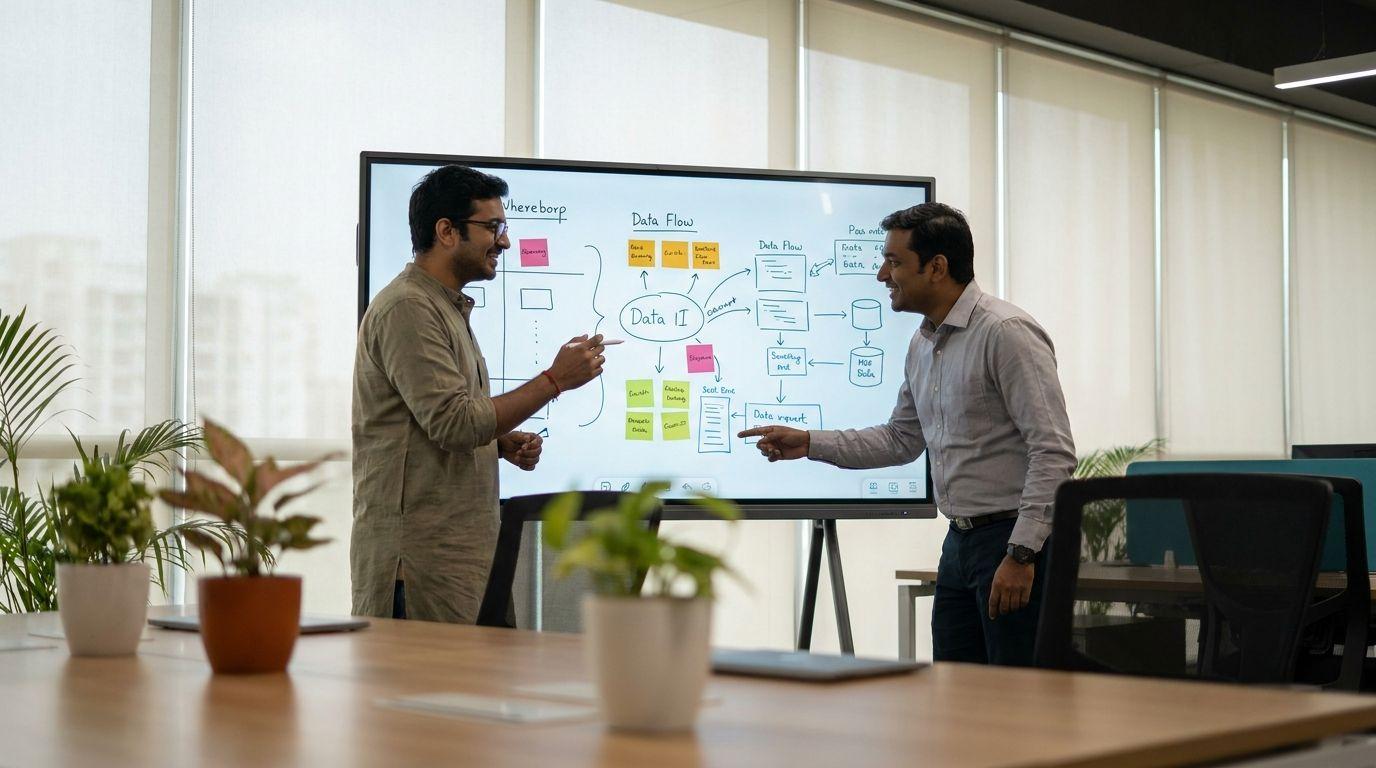
DPDP Act Compliance: Building India's New App Consent Architecture
India's DPDP Act and 2025 Rules mandate verifiable consent managers, ending legacy 'I agree' checkboxes. Learn how to overhaul your app's data architecture.

India's DPDP Act Compliance Mandates App Architecture Overhauls
India's DPDP Act imposes strict regulations on how custom software manages user data. Learn how to mandate consent flows and secure data deletion from your development agency.

Google's 24-Hour Wait for Sideloaded Apps: What Founders Must Know
Google is rolling out a mandatory 24-hour delay for sideloaded Android apps. Here is why non-technical founders must abandon direct APK downloads and pivot their user acquisition strategy.

Google Limits Android Sideloading: A Founder's Guide to Internal Apps
Google's new 2026 security updates automatically block unverified direct APK installations. Learn how your business must transition to EMM to keep field operations running.

Cloud GPU Costs Surge 79% Amid AI Boom: A Founder's Guide
With AI features driving cloud bills up by nearly 80%, founders must immediately audit their infrastructure and right-size their models to protect SaaS margins.

How to Survive the 79% Surge in Cloud GPU Costs
With cloud AI infrastructure costs spiking, unoptimized AI products are burning cash. Learn how non-technical founders can drastically reduce cloud GPU costs and protect their margins.

DPDP Act Compliance India: New Order on Consent & Data Audits
The October 2026 DPDP Order clarifies consent workflows and strict data audit requirements. Here is how founders must adapt their app architecture before the May 2027 enforcement deadline.

Anthropic Expands Claude AI Startup Program in India
Anthropic has broadened its startup program in India, offering over $50,000 in software discounts and API credits to offset early-stage LLM inference costs.

Google Launches Isolated Gemini AI for Indian Firms: A Guide
Google's new air-gapped AI offering allows Indian businesses to run Gemini LLMs without a public internet connection. Here is why fintech and healthtech founders should evaluate it.

The PixelLeak Crisis: A Founder's Guide to Secure AI Software Development
In September 2026, AI coding agents leaked 13,000 corporate screenshots to public repositories. Here is why your outsourced developers' AI tools are a massive security risk, and how to stop them.

How Much Does it Cost to Make an Educational App in India?
Discover the real 2026 costs of building an EdTech platform in India, from hidden cloud video fees to why the Build-Operate-Transfer model beats standard outsourcing.

AI Coding Security Risks: The 300-Company Data Leak Wake-Up Call
Security researchers found that AI coding agents accidentally leaked 13,000+ sensitive screenshots from over 300 companies. Here is what founders must do immediately.

Google Enforces Strict Android App Developer Verification
Google's mandatory identity and organizational verification rules are stalling app launches. Learn why securing a D-U-N-S number on Day 1 is critical.

Google Play Store Commission Cut: 2026 Unit Economics Guide
Google is restructuring its mandatory 30% app fee to an unbundled 15% effective model. Here is how non-technical founders should recalculate their unit economics.

Apple App Store Remove Cloud Icon: Surviving the 2026 App Purge
Apple is actively delisting stagnant iOS applications. Learn how to respond to the App Store Improvement notice, update your codebase, and prevent your business app from being permanently removed.

Audit Your App Now: Google Play Payment Policies Altered (2026)
Google's 2026 updates to Play Store billing allow external payments but introduce complex API compliance mandates. Here is how founders must adapt to avoid app delisting.

AI App Security: Why AI-Generated Code Leaks Your Data
Recent data leaks reveal AI coding tools often misconfigure cloud databases. Learn why founders must manually audit AI-generated backend code before launch.

Voice AI API Pricing Slashed by 95%: Time to Re-Evaluate Speech Apps
Alibaba has cut the cost of its top-tier voice AI models by 95%. If high speech-to-text API costs kept you from adding voice features to your product, it’s time to look at Qwen-Audio 3.1.

India's DPDP Act Forces Urgent Software Privacy Audits
India's DPDP Rules 2025 set an 18-month deadline with up to ₹250 crore penalties. Founders must upgrade their software data security and explicit consent flows now.

India's DPDP Act: Protean Launches Consent Platform
India’s Digital Personal Data Protection (DPDP) Act enters enforcement in 2027. Discover why buying a consent manager like Protean’s new platform is critical for your product strategy.

Google Play App Verification Deadline Approaches: Are You Ready?
Google's upcoming developer verification deadline means app owners must update their Play Console details immediately to avoid global delisting.

DPDPA Compliance Full Form: EdTech Software Not Exempt
Indian EdTech founders face fines up to INR 250 crore under the new DPDPA. Here's why education software isn't exempt, and how to audit your platform.

AI Coding Security Risks: Popular Tools Caught Uploading Local Code
Popular AI coding assistants have been caught silently uploading local code and project files to external servers, putting your startup's IP at risk.

iOS Payment Rules Are in Limbo: Why Founders Should Wait on the Supreme Court
Zero-commission iOS payments are a temporary legal anomaly, not a permanent shift. Here's why non-technical founders should wait for the Supreme Court before overhauling their billing architecture.

AI Software Development Costs in 2026: What CRED's 90% AI Code Shift Means
CRED's founder revealed that AI now writes 90% of the company's code. Here's what falling AI software development costs mean for non-technical founders in 2026.

Why AI Cloud Pricing Is Surging in 2026 (And How to Survive)
Major cloud providers are hiking compute prices as AI demand outstrips data center supply. Here's why AI cloud pricing is rising and how founders can protect their margins.

Unpatched GitSpawn Vulnerability Affects AI Coding Agents
A severe flaw called GitSpawn has compromised several popular AI coding agents, and four tools remain unpatched. Here's what non-technical founders need to do now.

India AI Governance Guidelines 2026: A Blueprint for Founders
India has formalized its AI governance guidelines. Discover how the 7 Sutras and the DPDP Act reshape your product architecture — and what founders must do to stay compliant.

Why AI Cloud Costs Are Spiking (And How Founders Can Stop It)
Generative AI can quietly wreck a startup's unit economics. Here's why AI cloud costs spike unpredictably, and how founders can cap AI API spend before it erodes margins.

DPDP Compliance for Software: Hardcoding Privacy by Design
India's DPDP Act means privacy policies are no longer enough. Learn why non-technical founders must demand privacy-by-design software architecture from their development agencies before writing code.

Apple App Store Payment Rules: Margin Wins for Apps in 2026
Apple now legally permits developers to link out to external payment gateways. Here's how to implement alternative app payments and improve your profit margins.

Managing AI Code Security Risks in Outsourced Software
Developers using AI coding agents are introducing scalable vulnerabilities into custom software. Learn how to mandate AI code security reviews in your outsourcing contracts.

DPDP Compliance India: An Operational Framework for Founders
India's DPDP Act requires strict data handling practices that go far beyond a privacy policy. Learn how to engineer your software for total compliance.

DPDP Act Compliance India: The Hidden Risks in Scraping Public Data
India's DPDP Act imposes strict rules on processing personal data — even data that's already public. Startups need to audit their scraping practices now.

India AI Law: Why Founders Must Adopt a Graded Risk Strategy
India is moving toward a dedicated, risk-based AI law. Non-technical founders building AI products need to assess their risk tier and document data sources now to avoid expensive rebuilds later.

Building DPDP Compliance Software: An Action Plan for Founders
India's DPDP Act imposes strict rules on how software manages data. Non-technical founders must act now to build legally compliant consent and deletion flows.

Zoho Catalyst AI: How Agent-Ready Serverless is Slashing Build Costs
Zoho's Catalyst 3.0 now gives AI coding agents direct control over serverless infrastructure. Here is what this means for founders evaluating custom software costs.

Google Play Developer Verification: How to Save Your App in 2026
Google is enforcing strict business identity verification deadlines for all Android developer accounts. Secure your D-U-N-S number now to prevent your app from being removed.

DPDP Act Compliance Solutions in India: Securing AI Data
The DPDP Act puts strict limits on how startups collect and use sensitive data for AI training. Here's how to architect privacy, consent management, and data protection into your software from day one.

Google Play Policy Changes: Strict New RAM Limits on Android Apps
Google is enforcing strict per-app memory limits and automated device migration rules starting in 2027 — non-technical founders should audit their Android apps now to avoid sudden delisting.

How Anthropic's 75% Prompt Caching Cut Lowers Claude API Pricing
Anthropic slashed the cost of processing recurring AI prompts by 75%. Here's how non-technical founders can use prompt caching to instantly lower API bills.

DPDP Act Compliance: State Readiness Signals Imminent Enforcement
With state governments now training regulators under DPDP Rules 2025, non-technical founders must treat DPDP Act compliance as urgent, not optional.

How Much Does It Cost to Build an App Like Swiggy in India? (2026)
Agencies pitch cheap clone scripts, but a scalable 3-sided food delivery marketplace needs serious architecture. Here's the realistic 2026 cost to build one like Swiggy.

The True Cost to Build an App With Base 44 in 2026: Why Founders Move to BOT
Base 44 promises full-stack apps for $20 a month, but fixing AI hallucinations and App Store rejections costs thousands. Here is the true cost of vibe coding.

Base44 Limitations: The Hidden Cost of Scaling an AI App in 2026
Base44 ships an MVP in days, but the Base44 limitations that surface at scale — credit burn, SPA SEO ceilings, and backend lock-in — arrive as a rebuild bill.

How Does IDEA Apply to Private Schools? (And the EdTech SaaS Opening It Creates)
IDEA's rules for parentally-placed private school students are a compliance bottleneck for public districts — and one of the least crowded B2B SaaS openings in EdTech for domain-expert founders.
Idea to App Instantly: 2026 Review of Famous.ai & Prompt To App
A 2026 review of instant AI app builders like Famous.ai and Prompt To App — where vibe coding genuinely wins, where it breaks in production, and what it takes to scale past the prototype.